Why Does My Child Cry at Drop-Off? Understanding Separation Anxiety
8/21/2026
Why Does My Child Cry at Drop-Off? Understanding Separation Anxiety
You unclip the car seat. They're fine. You walk through the classroom door. Still fine. Then it happens—the second your hand leaves theirs, the wailing starts, and you're left standing in the parking lot wondering if you've broken your child, ruined the morning, or both.
You haven't. This is one of the most common, most normal, and most misunderstood moments in early childhood. Let's talk about what's actually happening.
It's Not About the Classroom
Here's the thing most parents don't expect: separation anxiety usually isn't a sign that something's wrong at school. In fact, it often shows up *more* in kids who feel safe and securely attached at home. Your child cries because you matter. You are their anchor, their regulator, their safe place—and leaving that safe place, even for a wonderful classroom full of interesting things, requires a kind of bravery a three-year-old doesn't have much practice with yet.
Young children experience time and permanence very differently than adults do. You can hold the whole day in your head—drop-off, work, pickup, dinner, bedtime, repeat. A young child doesn't have that map yet. When you disappear, as far as their nervous system is concerned, you might be gone forever. That's not drama. That's brain development. The part of the brain that reliably understands "Mom always comes back" is still under construction.
So the crying isn't a verdict on your parenting or the school. It's a sign of a healthy attachment meeting an unfamiliar situation.
What's Actually Normal (And What Isn't)
There's no single official timeline for separation anxiety—every child, every temperament, every classroom is different. But here's a rough pattern that many parents and teachers report, offered as a general rule of thumb rather than a guarantee:
- The first week or two of a new program often bring the hardest mornings. This is common, not a red flag.
- By three or four weeks in, many children have settled into a rhythm, even if the goodbye itself is still a little rough around the edges.
- If a child is still deeply distressed every single day after a month or more, with no calming down afterward, it's worth a conversation with the teacher—not because something's broken, but because some children genuinely need more time or a different approach, and a teacher who sees your child daily can tell you what they're noticing.
What matters more than any calendar is a simpler question: how long does the crying last after you leave? Many children who cry hardest at drop-off settle within a few minutes once they're absorbed in something—sometimes before you've even reached your car. Ask your child's teacher what they actually see once you're out the door. That answer will tell you far more than the tears at the threshold do.
What To Do In The Actual Moment
All the ritual-building in the world doesn't help much when your child is wrapped around your leg, screaming your name, and there's a line of other parents behind you. So here's the part nobody tells you: what to do when it's happening, right now, in front of everyone.
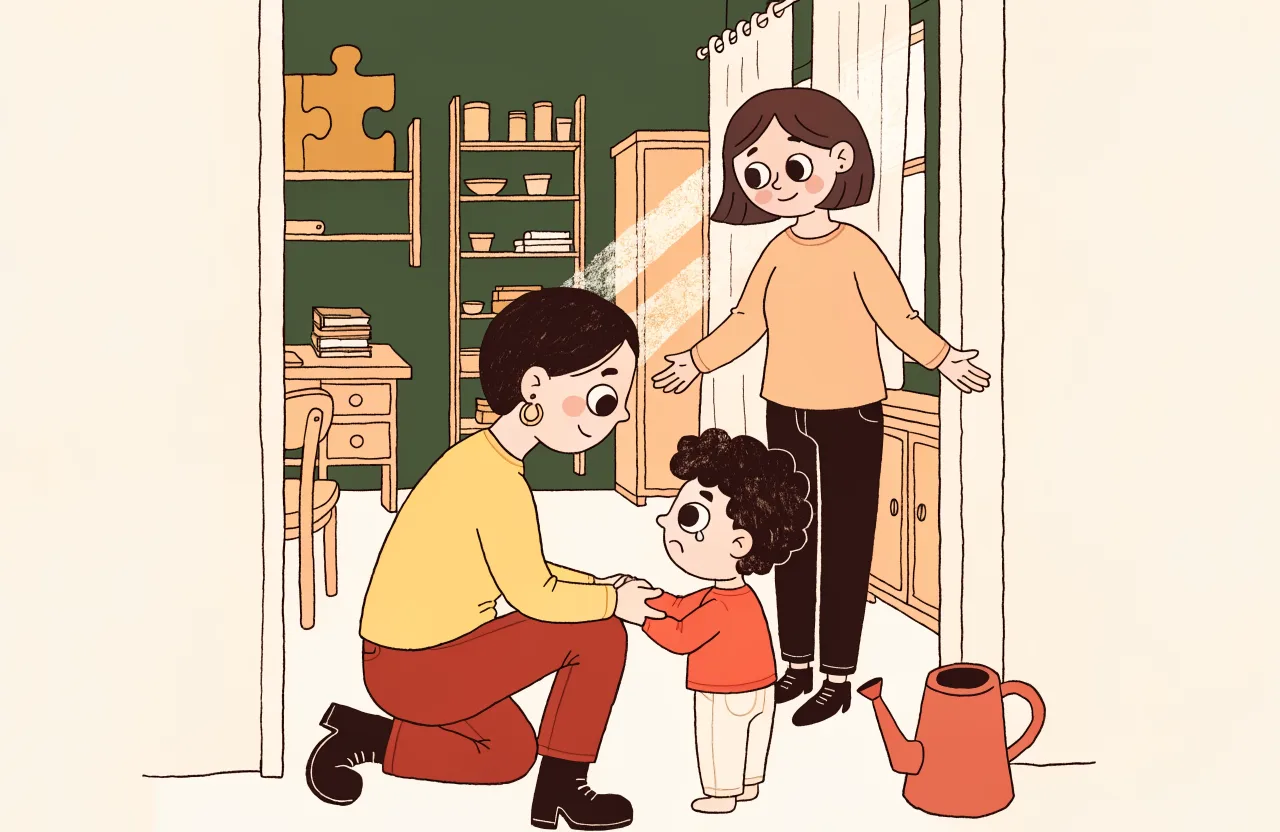
Get down to their eye level if you can. Say what's true and keep it short: "I see you're sad. I'm going to work, and I'll be back after lunch. You are safe here." Then hand them to the teacher—physically, not just verbally. A teacher's arms are a real, present alternative to yours, and your child needs somewhere to go, not just something to hear.
Resist the urge to ask "are you okay?" over and over, or to negotiate, or to promise a treat if they stop crying. These respond to the tears by making them the main event, which tends to prolong them. A calm, brief, loving exit—even while they're screaming—teaches your nervous system and theirs that this is manageable, not catastrophic.
And then leave. Actually leave. Lingering in the hallway to peek through the window, however tempting, usually makes things harder, not easier, because your child can often sense you're still nearby and holds out hope you'll come back for them. Walk out, cry in your own car if you need to, and trust the teacher to text or call if something is genuinely wrong. Most of the time, nothing is.
Why "Sneaking Out" Backfires
It's tempting. The crying is unbearable, so you think: what if I just slip away while they're distracted with the puzzle? Won't that spare us both the drama?
It won't. It'll cost you more later. When a child looks up and realizes you vanished without warning, they don't learn that goodbyes are easy—they learn that you might disappear at any moment without notice. That's a much scarier lesson than a hard goodbye. It often leads to clingier behavior, not less, because now they have to keep you in sight at all times just to feel safe.
The more reliable path is the opposite: a short, warm, predictable goodbye, every single time. Not a long, drawn-out one—but not a sneaky one either.
Reassurance Rituals That Actually Work
The goal isn't to eliminate the tears. It's to give your child a predictable structure they can lean on, even when their feelings are big. Predictability tends to be the antidote to separation fear, because fear feeds on uncertainty.
A few rituals that hold up well in real mornings, with real toddlers, in real traffic:
- Say goodbye the same way every time. A specific phrase, a specific hug, a specific hand squeeze. The content matters less than the consistency. "Two hugs and a wave" works because it's the same two hugs and the same wave every single day.
- Keep your goodbye short—genuinely short. Ninety seconds, not ten minutes. Lingering doesn't comfort a child; it signals that you're also unsure about leaving, and children read that instantly.
- Never leave without saying goodbye, even when it's tempting. Always tell the truth about when you're coming back, in terms they understand: "after lunch," "after nap," not "in three hours."
- Give them a job. Handing a child the responsibility of putting their coat in their cubby or watering the classroom plant when they arrive shifts their attention from your exit to their task. Independence is genuinely soothing—it's one of Montessori's quiet superpowers.
- Talk about the reunion, not just the goodbye. "When I pick you up, you can tell me what you built." This plants a small, comforting bridge to the future that a young child can hold onto.
None of these will make the tears vanish on day one. What they will do, over time, is teach your child something enormously important: goodbyes are safe, predictable, and always followed by a return.
When Home and School Don't Match
Separation anxiety often gets worse, not better, when home routines and school routines send different signals. If mornings at home are rushed and chaotic—shoes lost, voices raised, a hurried "bye love you go go go" shouted over your shoulder—and then school offers a calm, unhurried, ritualized goodbye, your child is living in two different emotional worlds five days a week. The mismatch itself can be part of what keeps the anxiety high.
You don't need to overhaul your whole household to fix this. Start smaller: pick one piece of your school goodbye ritual—the same phrase, the same two hugs—and use it at home too, for daycare drop-offs, grandparent visits, even when you leave the room to take a phone call. Consistency doesn't require a perfect morning. It just requires the same handful of words and gestures showing up in the same order, everywhere your child experiences a goodbye.
What This Is Really Teaching Them
It's worth remembering that separation anxiety, as hard as it is in the moment, is actually the beginning of something good. Every time your child survives a goodbye and discovers you come back, they're building a deep, bone-level trust that love doesn't disappear just because it's out of sight. That trust becomes the foundation for independence later: the confidence to try new things, meet new people, and handle new environments without falling apart.
The crying at the door isn't a sign of failure. It's evidence of a bond strong enough to feel worth protecting.
If drop-off has been rough at your house lately, you're already doing the most important thing by reading this far: paying attention. The goodbye at the door is just one moment in a much longer story about trust, rhythm, and what it takes for a small person to feel steady in a big world—and that story has a lot more chapters worth exploring.